Verification hardware lives in the least controlled places an organisation has: a hotel lobby at 3 a.m., a rental counter at an airport, a retail shop in a busy street. Security policies written for data centres do not survive contact with a device bolted to a reception desk.
What zero footprint means
Zero footprint is a design rule for the edge: a device that verifies identity leaves no trace of the people it verified. No image in storage, no cache, no local history. It is the difference between securing a thousand devices as if each were a data store and securing one processing environment while the devices hold nothing at all.
Conduits, not vaults
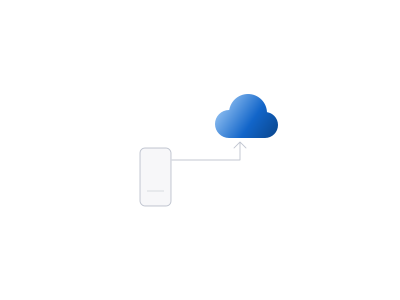
The scanner, the Station and the phone are built as encrypted conduits. They capture the document and the face, encrypt them, and send them to the cloud where the work happens. Nothing is processed, analysed or cached on the device.
That is what zero footprint means in practice. When a session ends, there is no image in local storage, no copy of the data in a temporary folder, no history of who was verified that day sitting on the machine.
The theft scenario, followed to the end
Take the worst case: a scanner is taken from a counter overnight. In a design that stored captures locally, that is a data breach with a list of every document the device ever read. In this design, the thief holds a capture device with an empty memory.
Because no data is stored or analysed locally, a compromised or stolen physical scanner reveals no customer data at all. The incident is a hardware loss, not a notification to every customer who passed through that counter.
Where the work actually happens
Everything that requires the document or the face runs server-side, in a hardened AWS environment built on SageMaker. All personal and biometric data is encrypted at rest and in transit. Concentrating the processing in one controlled place is what allows the edges to stay empty.
- On the device: capture and encryption, for the duration of the session only.
- In transit: encrypted end to end between the device and the cloud.
- In the cloud: the checks, the verdict and the audit record, without the image kept afterwards.
What it changes for your security team
Devices that hold nothing are devices that do not need to be treated as data stores. They can be deployed where the customers are, without turning each location into a site that has to be secured like a server room. The risk that remains is concentrated where it can be controlled.
What a lost device means after an incident
When a device that stored personal data goes missing, the GDPR expects the organisation to assess the breach and, where it creates a risk, notify the supervisory authority within 72 hours. A device that never stored any personal data leaves far less to assess: there is no list of affected customers to reconstruct, because there were none on it.
Questions about zero-footprint hardware
Does the scanner store any customer data?
No. It captures and encrypts for the duration of the session only. Nothing is processed, analysed or cached on the device.
What happens if a scanner is stolen?
The thief holds a capture device with an empty memory. Because nothing is stored or analysed locally, a stolen or compromised scanner reveals no customer data.
Where is the data processed?
Server-side, in a hardened AWS environment built on SageMaker, with all personal and biometric data encrypted at rest and in transit.